
Effects of Virtual Reality Feedback on Indirect Vision Performance in Minimally Invasive Endodontic Operations
Mirror handling is crucial during dental operations, and it requires precise eye-to-hand coordination. Practicing psychomotor skills requires context-specific design. Virtual reality and haptic technology enable the possibility of developing such specific environments. In this thesis, we explored the effectiveness of 3 mirror guidance methods in a dental simulator, including visual guidance, verbal guidance, and haptic guidance, and compared them against each other as well as the control group without guidance.
The randomized balanced Latin square 4x4 crossover design was conducted with 20 participants. Performance data was collected automatically by the system during the entirety of the session. In addition, system usability data was collected at the end of each session using the Virtual Reality System Usability Questionnaire (VRSUQ). The results showed that none of the guidance conditions performed significantly better than the control group.
Description
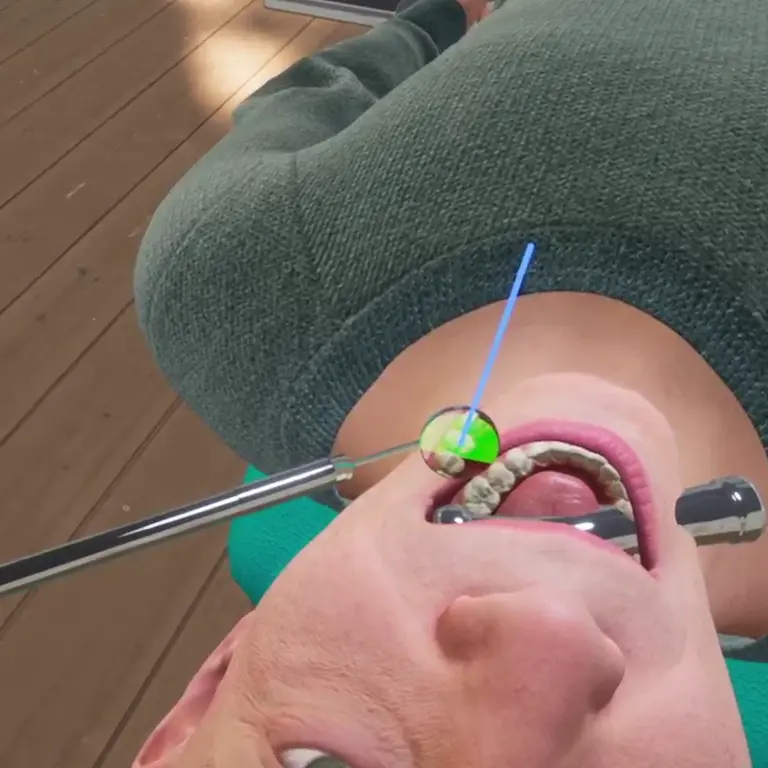
Posture notification and 3 mirror guidance methods were implemented into the Dental Simulator. The posture notification was implemented from the recommendation of the expert regarding ergonomics. The system played a notification sound when the posture is incorrect. For mirror guidance, each guidance method was applied differently based on 3 guidance conditions, including when the mirror is outside of the optimal area (Condition 1), when the mirror is incorrectly oriented (Condition 2), and when the tooth is occluded in the mirror view (Condition 3).
Visual Guidance
- Condition 1: Visualize the optimal area as a notification to move the mirror to the area
- Condition 2: Visualize the ghost mirror and tooth reflection line to help the user in the adjustment of the mirror
- Condition 3: Visualize the ghost mirror in the location where the line of sight of the tooth is not occluded in the mirror
Verbal Guidance
- Condition 1: Play the notification sound "move mirror to the mouth"
- Condition 2: Play the notification sound "adjust mirror"
- Condition 3: Play the notification sound "tool tip is not visible"
Haptic Guidance: This guidance method saved the last location where the tooth was visible.
- Condition 1: Apply haptic direct force toward the optimal area
- Condition 2: Apply haptic direct force toward the last location where the tooth is visible if the distance difference between the current location and the saved location exceeds a threshold. Otherwise, apply haptic noise
- Condition 3: Apply the direct force toward the location where the line of sight of the tooth is not occluded in the mirror
Results
The user study was conducted with a total of 20 4th-year dental students. Several metrics were used as measurements and categorized as follows:
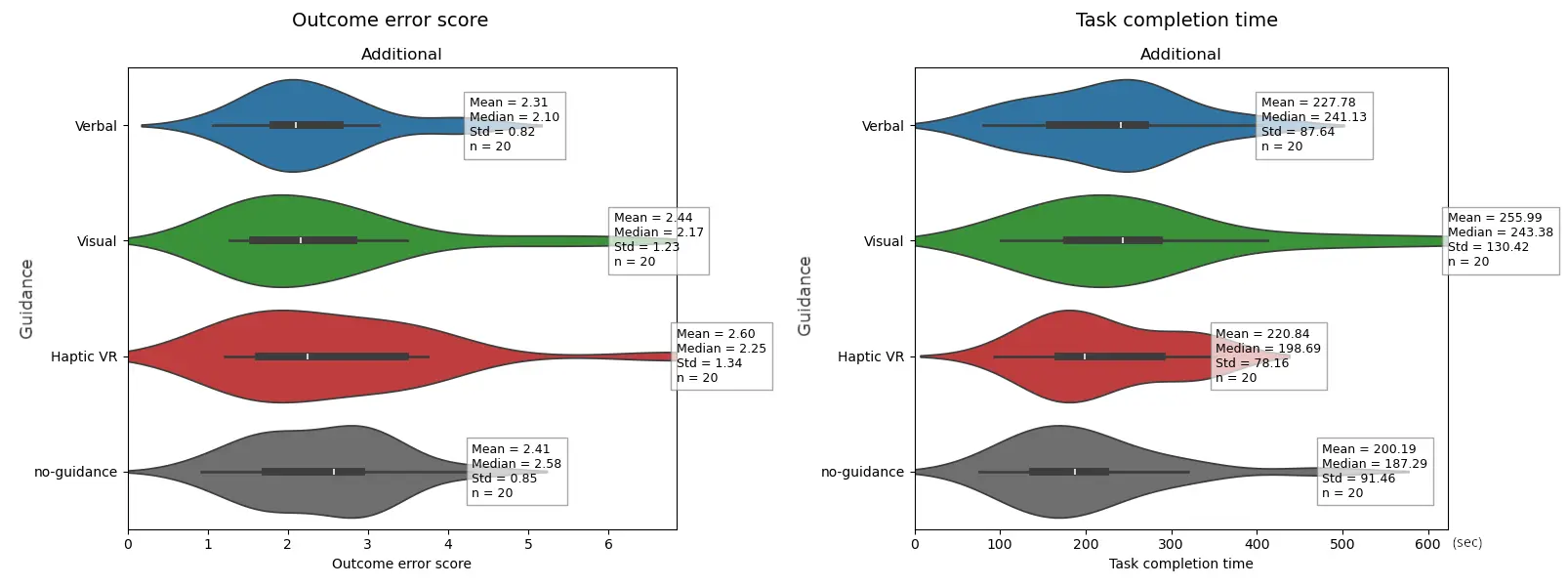
- Task Performance: Outcome Errors Score and Task Completion Time
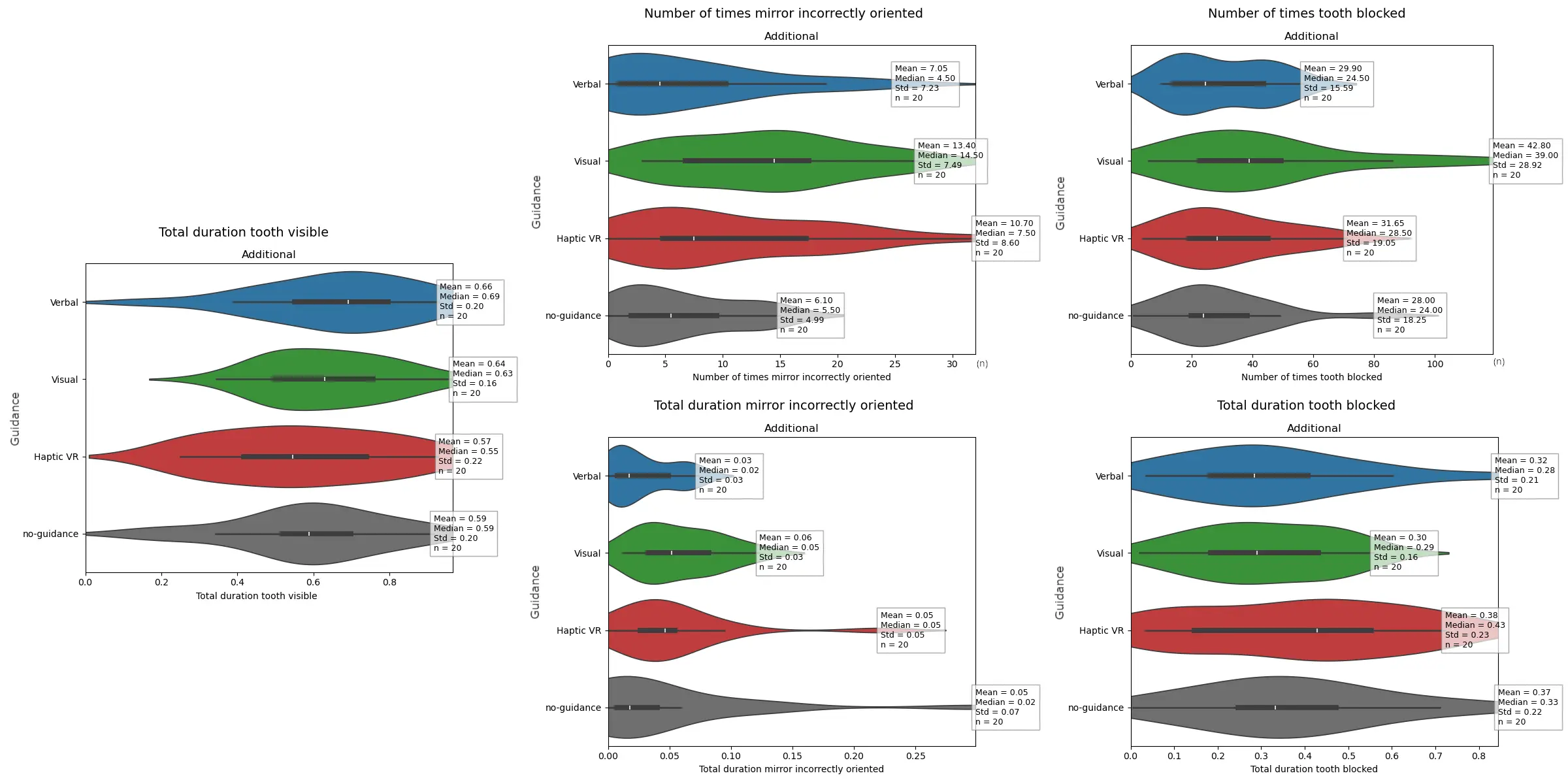
- Mirror Handling Performance: Tooth Visibility Duration, Incorrect Mirror Orientation, and Tooth Occlusion
- User Evaluation: VRSUQ and Participants' Comments
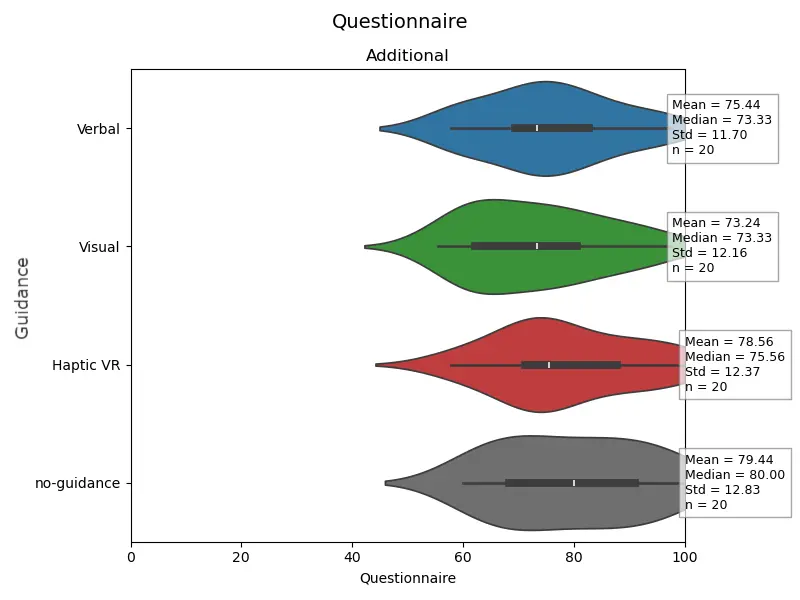
The results showed that none of the guidance conditions performed significantly better than the control group across all metrics.
Files
Full version of the master's thesis (English only)
Presentation of the thesis can be found here
Source code repository can be found here
License
This original work is copyright by University of Bremen.
Any software of this work is covered by the European Union Public Licence v1.2.
To view a copy of this license, visit
eur-lex.europa.eu.
The Thesis provided above (as PDF file) is licensed under Attribution-NonCommercial-NoDerivatives 4.0 International


 .
.
Any other assets (3D models, movies, documents, etc.) are covered by the
Creative Commons Attribution-NonCommercial-ShareAlike 4.0 International License.
To view a copy of this license, visit
creativecommons.org.
If you use any of the assets or software to produce a publication,
then you must give credit and put a reference in your publication.
If you would like to use our software in proprietary software,
you can obtain an exception from the above license (aka. dual licensing).
Please contact zach at cs.uni-bremen dot de.